|
There are numerous musical instruments that have a history beyond them – from bagpipe to violin in western folk. Bouzouki, the symbol of Greeks from Asia-minor (Rum- in Turkish, referring Eastern Romans/ Byzantium Empire), has one of the most sensational and melodramatic story among all of them. The Bouzouki was reintroduced and brought to Greece by immigrants from Asia Minor and Turkey in the early 1900's. The Trichordo Bouzouki has three pairs of strings, each pair tuned the same. It is tuned to "re", "la", "re", (d,a,d,) The (re) string is the basis for the melody, while the A and second D strings are used for playing chords. The first bottom (D) string is known as Kantini. The sound of the top (D) string is known as Bourgana. In the olden days, the Bouzouki was tuned to accompany the different modes (styles of songs) being played. This type of tuning is called Ntouzeni (Du-zeni), and is essential to preparation to playing. The bouzouki is played with a pick, but in the past it was played with a feather or a piece of wood carved from a cherry tree. This helps to create the distinctive sound of Bouzouki playing.” (Skordilis, S.) Du-zeni, düzen means “order” in contemporary Turkish language and it is coming from the Old Turkic “tüzenlik/tüzülük "tertip, intizam" [ Tuhfetu'z Zekiyye fi'l-Lugati't-Türkiyye (1425)” “Turkish – Adjectivedüzensiz (comparative daha düzensiz, superlative en düzensiz) In early 1900’s, there was a new düzen (order) was being staged for the both sides of Aegean (Ege in Turkish), not only people from those two civilizations- Greeks and Turks had casualties and were exposed to forced exclusions (from one region to another), but also people from the groups of other national/ethnic/religious backgrounds (Armenians, Bulgarians, Gypsies, Jews) in the region, were in the pavement of a stinged road. Ottoman- Young Turks were in a revolt to the falling monarchy and were in an endeavour to establish the new republic , in its modern form. During, 1912-1913 Balkan-wars, many of the Turkified and Muslim groups (called Muhajirs in Turkish- referring a refugee) had to leave their motherlands and flee to the eastern Thracia and Asia minör (nowadays Turk-land). Prior to WW I , things were boiling up in Macedonia (referring a shared region between Greeks, southern Slavs, Turks). Rembetika’s, the Anatolian Greeks were also left in a dilemma whether to stay in Anatolia or to return to the Macedonian region of Greece (western Thracia) which were re-gained by Greeks during the Balkan wars, 1912-1913. After the treaty of Lausanne- 24th July 1923- the warranty of the new born Turkish Republic, which ended up the war and established the final borders of nowadays Greece and Republic of Turkey, Mustafa Kemal Atatürk and Eleftherios Venizelos agreed upon a population exchange policy (mübadele in Turkish, antallagi in Greek) following the peace-keeping endeavors between the two nation-states. “No one asked the opinion of the people affected, of course, though their identities as Greeks and Turks, Christians and Muslims were far less clear-cut than the Lausanne arrangement implied. The Times of London reported in 1923 that “few if any of the Turks in Greece desire to leave,” and Christians in Turkish Cappadocia and Constantinople struggled to exempt their ancient communities from the exchange. Orthodox Christian and Muslim communities had lived side by side, if not always amicably, for centuries before the rise of nationalism, and minority groups had assimilated aspects of the language, customs and religious practices of their birthplaces. Many Ottoman Christians had converted to Islam. In Turkey, some had continued to practice in secret as “crypto-Christians,” and in many cases later returned to Christianity; while in Greece, converts to Islam retained aspects of Christian practice in their Muslim ritual. Such multilayered religious backgrounds could not be easily categorized. Linguistic boundaries were equally blurred. Refugees arriving for the first time in Turkey or Greece felt like strangers in their supposed homelands, often unable even to speak the language, and facing hostility from their new neighbors.” (Cooper, B. 2006) At that time period; Bouzouki, was standing as a mermaid in the endless ocean at where a ship is lost in its route due to the foggy weather. The Anatolian Greeks (Rebetika’s, Rum in Turkish) who had to leave Asia-minör (so were Turks had to leave the mainland Greece) had a shared story (a spiritual person may call this a destiny). The Muslim Cretans , when arrived to the new established Turkish Republic, were not able to express themselves fluently in Turkish, but only in Greek. The same applied to many of the Greeks from Asia-minör. Rebetika’s had saz /bağlama (baglamas in Greek) typed of instruments which were the shared heritage of Armenians, Assyrians, Kurds, Greeks, Persians and Turks ) – alphabetically ordered. According to the story tellers (an undocumented history), during the population exchange, one of the Greeks got his bağlama broken on the way. The strings on his bağlama’s (baglama in Greek) was teared up and when he arrived to Thesselanoki (Selanik in Turkish- the birth place of Atatürk and Nazım Hikmet) Giannis takes his broken instrument to the repair guy. The handy man responds when he sees the instrument “Bouzoukia vre !” deriven from the word “Bozuk” in Turkish, which means damaged. The repair guy switches the old strings with the new but different kinds. Bouzoukia, then created in its new tune. “The (baglama) is a smaller version of the Bouzouki. The baglama is tuned (re,la,re) exactly like the (trichordo) Bouzouki. The baglama was an easy instrument to carry because of its small size. Today the baglama is used to add color and to give a precise, distinct, vibrato sound to the composition. In the 1950's the bouzouki with four pairs of strings was introduced. The three strings limited the musician to playing the "Rebetika" songs only. The four strings gave a new dimension to the capabilities of the instrument. The new Bouzouki that was developed in the fifties is named (tetrachordo) and has four pairs of strings that are tuned (c,f,a,d). The chords played on the Bouzouki are the same as a guitar. A distinct characteristic of the Bouzouki is the taxim.” (Skordilis, S.) Samples of Bouzouki Performances: https://www.youtube.com/watch?v=zx-a_17OVc4 https://www.youtube.com/watch?v=87WaObhHPv4 REFERENCES: Cooper Belinda. Sunday Book review , Trading Places (September, 17, 2006) Skordilis Spiros . Talks about the History of the Bouzouki http://www.etimolojiturkce.com/kelime/d%C3%BCzen http://www.engyes.com/en/dic-content/d%C3%BCzensiz Thank you to Cagin Koray for this fascinating guest blog about the history of the Bouzouki, an instrument that most people will recognise yet know little of the history and cultural background.
3 Comments
Open Cambridge 2016
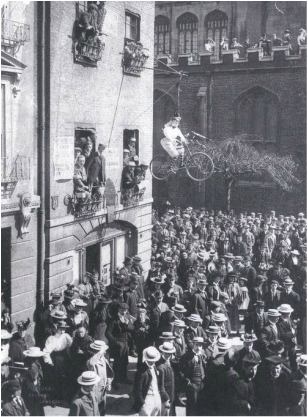 Image courtesy of Dr Sheila Hanlon and Newnham College Image courtesy of Dr Sheila Hanlon and Newnham College Come and join us at Great St Mary's Cambridge on 10 September between 11.00 am and 4.00 pm for this year's Open Cambridge event, funded by Cambridge Bid.
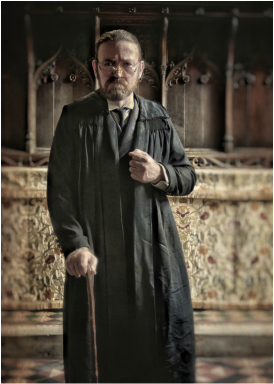
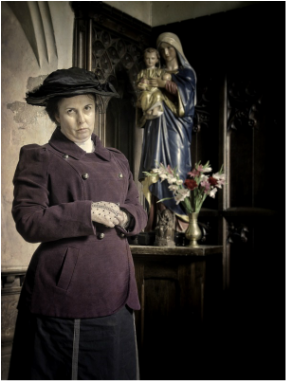
As part of the event, we'll be recreating the infamous 1897 protest against the introduction of degrees for women. Matthew will portray a crusty professor who thinks women should know their place, Gill will play an old fashioned Victorian lady who leaves thinking to her husband, and Rachel Duffield will portray the bluestocking who thinks it's high time there was education for all. Join us at 1.00 pm for a public debate and have your say. Thanks to funding from Cambridge BID there will be a wide range of activities in and around the market on Saturday 10 September, including mini historical market tours, time-travelling market traders from medieval times to the swinging sixties, and children’s activities in Great St Mary’s. The Museum of Cambridge are setting up a pop-up exhibition and memory stall where they hope to collect local people’s memories of Cambridge Market. You can also take a walking tour all about trade and shopping to the Museum, which is offering free entry. At 4pm, join us in Great St Mary’s for a talk by renowned local historian Mike Petty about the changing faces of the market through history and unusual ideas about how to transform it for the future. There’s no need to book for this free family event, with activities taking place in the market from 11am-4pm, and the evening talk in Great St Mary’s from 4-6pm. You can find more information on the 1897 protest at Dr Sheila Hanlon's excellent blog. 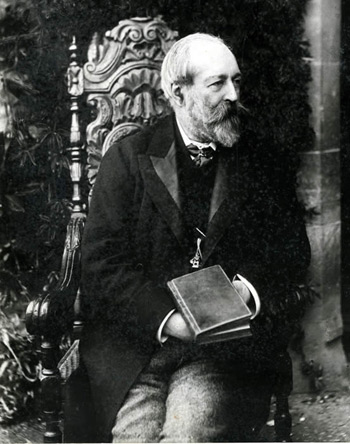 G.F. Bodley c. 1900, courtesy RIBA G.F. Bodley c. 1900, courtesy RIBA The names of Augustus Welby Pugin, Edwin Lutyens and the Gilbert Scotts are rightly recognised in the annals of British architecture. Perhaps George Frederick Bodley is largely forgotten in the popular pantheon of great architects, but he thoroughly deserves his own place of honour. Born in 1827, Bodley studied architecture under Sir George Gilbert Scott and rose to become a pre-eminent ecclesiastical and corporate architect of the later Victorian era. Many of his commissions are Grade I listed and his fame proceeds beyond Britain, with Washington National Cathedral and St David’s Cathedral, Hobart bearing his mark. Bodley designed pleasant, practical buildings that were well made and often beautifully decorated. His is a genius of competence as his work still stands where others have crumbled under the onslaughts of pollution and progress. High quality materials, shaped with simple elegant designs, have ensured Bodley’s buildings shrug off British weather, more than a century of corrosive smog and 1960s progressive vandalism. This week, we are celebrating one of Bodley’s gems in Cambridge. All Saints, Jesus Lane was built in the 1860s to replace a medieval parish church which stood where All Saints Gardens are today in the centre of Cambridge. Bodley designed the fabric and decoration of this church as an harmonious whole and employed William Morris, Burne Jones and Kempe to realise his design. The pulpit is as beautiful and brilliant as any Gothic revival item in the V&A, and Bodley’s font is a good companion to the medieval font preserved from the old All Saints church. The V&A celebrated the brilliance of Bodley with a major exhibition in 2007-8, marking the centenary of his passing. Michael Hall, curator of the exhibition, also wrote an accompanying book, George Frederick Bodley & the Later Gothic Revival in Britain and America. http://yalebooks.co.uk/display.asp?k=9780300208023 Bodley’s design was a great success and the parish prospered, only faltering long after Bodley’s passing. The church was declared redundant in 1973 and initially marked for demolition. A determined and organised friends group successfully saved this masterpiece and care is now vested in the Churches Conservation Trust. The CCT received a grant from the Heritage Lottery Fund to revive and reinterpret All Saints for the C21st. A new doorway now links it to Westcott House next door, enabling the theological college to make ever more use of the church. New interpretive materials have been installed to enable visitors to understand the story of All Saints, the architecture, decorations and the brilliant artists who created it. We shall be performing as G.F. Bodley and his wife, Minna Reaveley at All Saints’ launch event on Friday 29 April. Bodley’s character and work will be brought to life in a recreation of his study. Visitors will also be able to meet Bodley and Minna on Saturday 30 April, and learn about Victorian art, architecture and poetry as part of a special , free open day. There will be a Victorian photography ‘selfie’ studio as well as sketching, stencilling and Victorian writing. 10.00 - 16.00, 30 April 2016, All Saints Church, Jesus Lane, Cambridge CB5 8BP. Entry FREE http://www.visitchurches.org.uk/Whatson/Fulleventslist/2016-04-30/Exploring-All-Saints-Cambridge/ 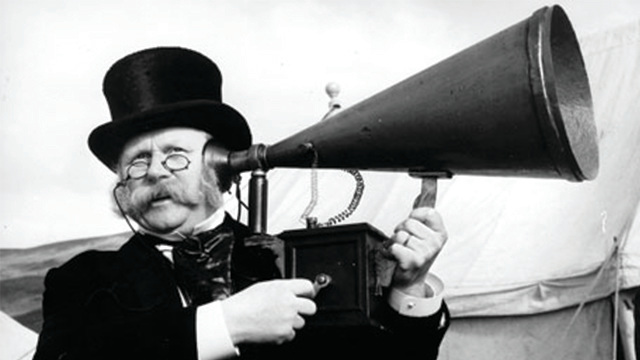 First published at LinkedIn, 4 November 2015 A huge thank you to all who have connected with me here at LinkedIn. Some of you are people I know 'in real life', some of us have worked together, and many of you are in the heritage sector, the sector my business (which I run with my co-director, Matthew Ward), HistoryNeedsYou primarily works with. Am I here to market my business? Yes, of course. I am also here to share, learn, and most of all, LISTEN. Social media is an area the heritage sector can be a little wary of. What's in it for me? (I hear you cry). The answer is plenty, if you know where to look, what to do, and how to listen. Listening is key. In your case, listening to your visitors and potential visitors, and in my case, listening to you. Together, we'll work to communicate in a way that will interest, engage, and draw in visitors. LinkedIn seems well-supplied with LinkedIn/social media experts. There are many 'how to' posts ranging from the useful to the not-so. Many of them amuse me by their insistence on the 'right' and 'wrong' way. THIS, they cry, is what LinkedIn is for, and THIS is how you do it. Hard to engage with or listen to.  HistoryNeedsYou has a Twitter following of over 42,000, and our total social media following across all channels is around 350,000. Not by telling people 'how to do it'. We listen, we learn, we engage and we do it. Let us help you do it too. Our followers range from individuals to historians, broadcasters, museums, heritage organisations, heritage professionals, blue chip companies and to the leading experts in the history/heritage field. Worldwide. Proof. Puddings ... So ... talk to me about what you want us to help you achieve through social media. Tell me what your difficulties are. Tell me what you've tried, what worked, and what didn't. I'm listening ... Contact us using our contact form, leave us a comment below, or email us at info at HistoryNeedsYou dot com. We look forward to hearing from you.
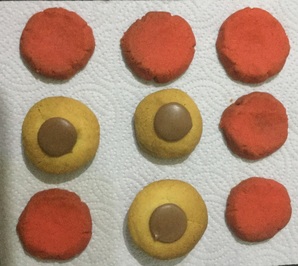 Our work, as HistoryNeedsYou, concentrates on communicating History by making it fun, engaging and relevant. We also apply our ethos to communicating other subjects including poetry, drama, literature, engineering and science. Here’s a fun way to learn a little bit of biology, inspired by a homework question. Homework challenge: make a 3D model of a cell, animal or vegetable. Homework solution: bake blood cell biscuits, showing white and red cells. Make a biscuit (cookie) mixture, colour 3/4 red, form into blood cells and bake. 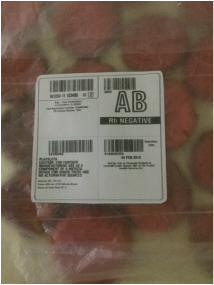 Ingredients 250g plain flour 250g butter 125g castor sugar Ginger Paprika Red food colouring Chocolate buttons Plastic sandwich bags Blood-bag labels Method
Cream the butter and sugar and gradually beat in the sifted flour. Add ginger to taste. Make into a stiff paste. Set 1/4 aside for the white blood cells. Add red food colouring and a dash of paprika to the mixture for the red blood cells. Beat it in until the colour is even and of a good deep red colour. Form into small balls and place on a greased baking sheet. Press each ball flat with a round spoon to form the distinctive shape of a red blood cell. For the White blood cells, form into balls twice the size of the red blood cells and do not press flat. Bake in a warm oven until the biscuits are firm but only just browning. Ten to fifteen minutes at 180C is usually sufficient but ovens vary! When cooked, remove from oven and allow to cool. When the White cells have cooled slightly, place a chocolate button on top of each one to represent the cell nucleus. The warmth will make the chocolate stick to the cell. Leave the biscuits to thoroughly cool before bagging up. Stick a blood-bag label on each bag. You can make your own or find one on the interweb. Add the biscuits to the blood-bags, ensuring a mixture of red and white cells. Present your homework and hope for a good mark. If your teacher isn't impressed then you can eat the biscuits to cheer yourself up! Sharing biscuits with school friends is a sure way to increase your popularity! The big historical story of the day is that Mark Griffiths, a botanist and columnist for Country Life, has claimed to have discovered the only image of William Shakespeare made during his lifetime. http://www.countrylife.co.uk/features/world-exclusive-the-true-face-of-shakespeare-revealed-for-the-first-time-video-72243 Griffiths made this sensational claim about a figure on the frontispiece of Gerard's Herbal. He has cracked what he claims to be a secret Tudor code - but there is no code or secret to decipher. The figure and the emblems associated in the engraving are linked with one man, Sir Francis Drake. It was Drake who brought corn (which the figure in the illustration is holding), tobacco and potatoes to England in 1586 when returning from the Roanoke colony. It was Drake who was associated with the Snake's Head Fritillary, which the figure is also holding, having being sent the flowers by Charles de L'Ecluse. John Gerard is depicted on the frontispiece holding a potato plant. This potato was given to him by none other than Francis Drake. Gerard's great innovation was to include descriptions of the exciting new plants from the Americas, whilst many of the older plants were based on an earlier work by Rembert Dodoens. We know that Gerard's description of the potato was based on what Drake told him. This was the first description of the potato in English literature. Furthermore, the image in the engraving looks nothing like any existing images of Shakespeare but does look just like Francis Drake. This portrait of Drake, courtesy Philip Mould, is strikingly similar to the engraving. http://www.historicalportraits.com/Gallery.asp?Page=Item&ItemID=1312&Desc=Sir-Francis-Drake-%7C--English-Sixteenth-Century-School 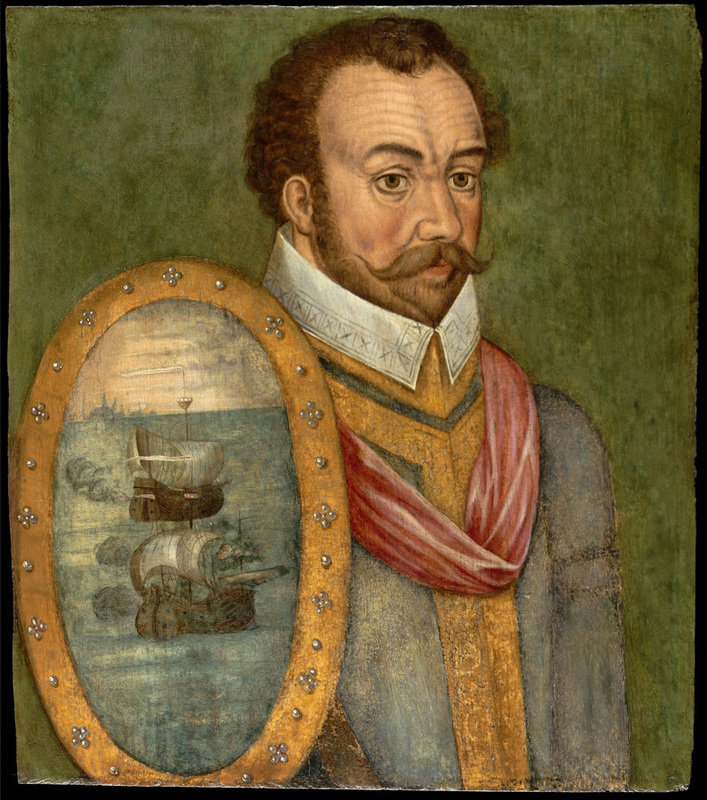 References
Corn: Sir Francis Drake's West Indian Voyages, 1585-1586, Ashgate Publishing, 1991 Snake's Head Fritillary: Bulbs, A complete handbook, 1973 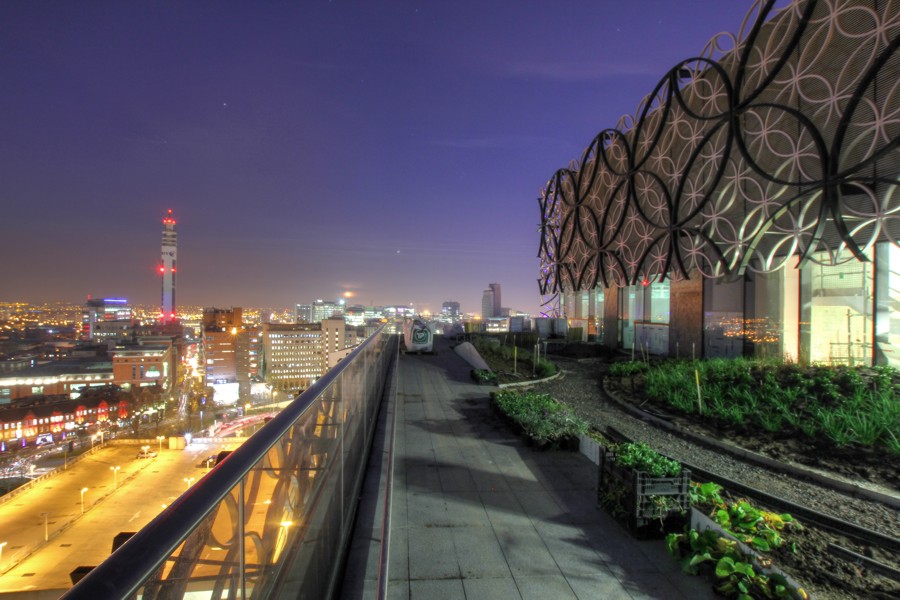
Matthew will be speaking at the Theatre in Education training day, for museum and heritage professionals, being held at The Library of Birmingham on 17 February.
The excellent line-up, in full, is: Matthew Ward, HistoryNeedsYou The play's the thing! Seriously engaging fun - historian and broadcaster Matthew Ward, of HistoryNeedsYou, will share his experiences in lighting the touch-paper of imagination, inspiring diverse audiences to have a passion for history and heritage. Matthew worked on three series of Horrible Histories and was the historian for the new BBC film Testament of Youth. HistoryNeedsYou works with a wide variety of organisations including heritage and educational bodies, broadcasters and cultural groups. Warning: this presentation may contain jokes. Pyn Stockman and Mandy Ross, Secret City Arts Out of the archive and onto the stage - creative performance-making with children and young people using historical research and archive images. Matt Hinks, Big Brum: Talking about WW1 - The End of Reason 1914-1918 A talk about the creative and TiE process used at Highbury and plans for the Taking 2 audio project. Gemma Dhami, Museum Development Officer for Worcestershire, and Rachel Shepherd, Avoncroft Museum, Bromsgrove Animating Worcestershire's Museums runs from April 2014 to March 2015 and has been a collaborative project between 6 museums in Worcestershire to create a quality costumed interpretation offer in the county. As part of the project we have had a huge amount of costume produced, provided a number of training days and created an online volunteer recruitment portal. Rachel Sharpe, Croome Redefined, Local Partnerships Officer Developing Live Interpretation – The Do’s and the Don’ts! Rachel has worked as a teacher, writer, director and outreach officer for the past 18 years. From leading Europe’s largest cultural heritage site-specific community performance, to her current role at the National Trust developing a live interpretation offer which tells Croome’s unique stories in a very different way! Croome Encounters has been a huge success for the property, taking visitor experience to the max; not only rehearsing in front of visitors but making them part of the audition process. Rachel’s workshop will take you through their journey, an honest account of what did and didn’t work, with lessons you can apply at your own museum or property. Tickets are £10 for members, £15 for non-members and are available by emailing Sue Pope, Learning, Volunteering and Partnerships Manager, Museums Worcestershire. Attracting and engaging an audience is one of the primary concerns of the heritage sector. Young and enthusiastic visitors are vital to the survival and prosperity of our heritage. There are as many ways to attract an audience as there are brilliant books in the Bodleian. The only limiting factors are imagination and courage. Packwood House, a charming National Trust property in the heart of England, has imagineered a new attraction that engages and enthrals with whimsy and wonder. Færie houses peek out from the ornamental garden, a princess's bed proudly peruses the lake and a winsome witch's cottage waits in the wood. The #PackwoodFollies were created by Hilary Jack, an artist from Manchester who has worked from Brooklyn to Budapest. I interviewed Hilary about her work and inspiration. 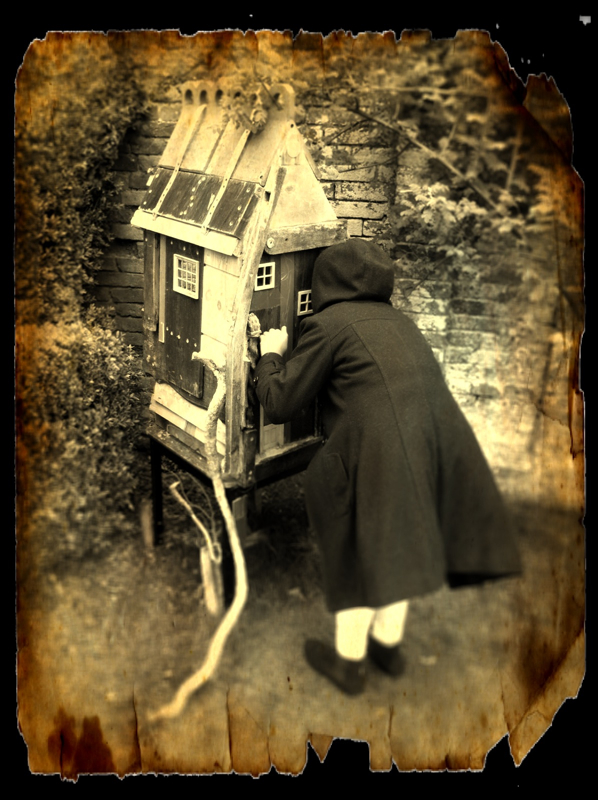 Searching for færies in the Packwood Follies What inspired you to create the Packwood Follies? I work across media often using reclaimed broken objects which I use in site referencial installations and sculptural work. While I was researching the background for my proposal for Packwood Follies I became aware of the quotation by a visitor, “a house to dream of, a garden to dream in” which sums up the uncanny, dreamlike experience of visiting Packwood, the fact that all is not as it seems. Graham Baron Ash the last inhabitant of Packwood House had salvaged a large quantity of reproduction and antique Tudor furniture, fixtures and fittings. He used the reclaimed furniture to create an evocation of a Tudor mansion House albeit in the twentieth century, effectively turning back time fort he visitor. I wanted to reference these facts in the artworks I made, the choice of materials and the differing scale of the works. It is noticeable that the Follies engage and enthral all visitors to Packwood. Did you consider the potential audience for your follies? It was part of the brief for Packwood Follies that the artworks should be accessible to all age groups. All three follies can be experienced at different levels, simply as spaces to be explored and as conceptual contemporary art which references the history and particularities of the site at Packwood and enhances the visitors experience perhaps highlighting aspects which have previously gone unnoticed. Packwood Follies are constructed primarily of up reclaimed furniture and have a limited lifespan displayed outdoors. What plans or dreams do you have for creations in brick and stone or cob, wattle and daub? Most of the structures I make have already been discarded and have a limited lifespan, my intervention extends the life of these objects which I've selected because of their histories and purpose. Packwood Follies is made to last for about three years and I believe the installations will change over time and become more embedded in the landscape and the history and mythologies of Packwood. Packwood is in the geographical centre of England. Where else in the country or the world can people see your projects? My next commission is for Barnaby Festival in Macclesfield nr Manchester in June. I'll be making another InsideOutHouse using reclaimed office furniture. The theme for the art festival is Industry and the structure will be positioned outside the town hall. Exploring Packwood Follies We discovered the follies courtesy of a photo tweeted by Packwood House @NTPackwood - love at first sight of a mysterious cottage in the woods. Choosing to explore without guidance, we started our search in the ornamental yew garden. Three petite palaces, perfect for pixies, prettified the parterre. Their diminutive size was delightful to the younger visitors who were eager to discover the residents. Attractive architecture and audacious artifice, on a small scale, were equally attractive to heritage geeks, grandparents and garden-lovers. 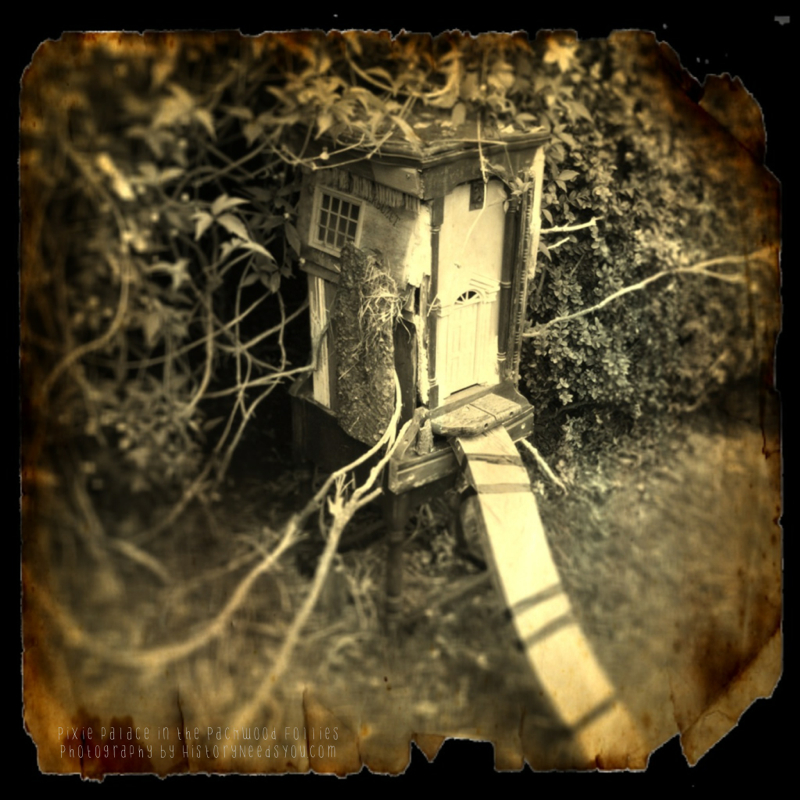 Pyxie palace in the Packwood Follies Beyond the pale and the pond, a princess's bed enticed visitors to explore the lake and woodland walk. Carved from a fallen oak tree and upholstered with turf, anachronistic and anatopismic yet utterly right in execution and location. The craggily carved pillars whisper Delphic dreams and the turf-mattress entreats Tudor secrets. From 'the Princess and the Pea' to 'Beauty and the Beast' this was not aloof and esoteric art but a playpen for the imagination. 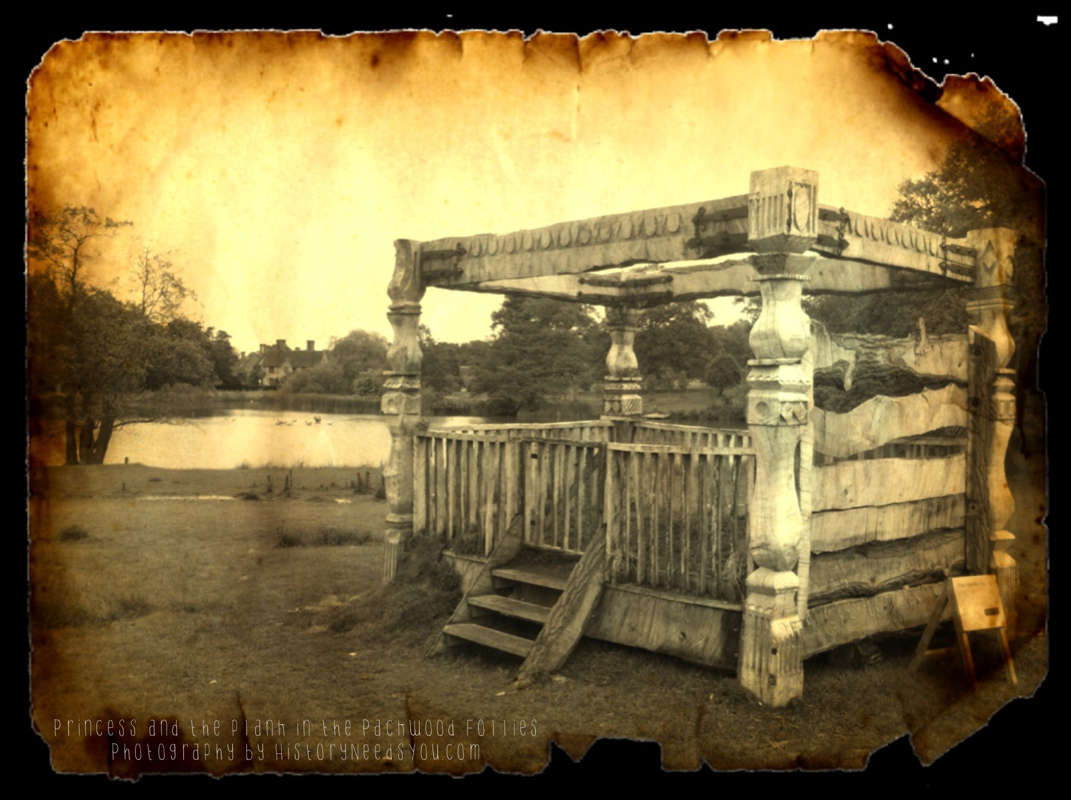 Princess and the plank From the verdant lakeside pasture we passed into the tulgy wood, searching for the cottage that had first enticed us to visit. Hansel and Gretel, Vasilisa and Snow White, our imaginations had been visualised by Hilary Jack in this amazing inside-out cottage. The outside is clad in salvaged Tudorbethan furniture whilst the inside contains an enchanted glade. This is the Wendy House that everybody has always dreamed of. All the visitors were enraptured and entranced by the sylvan sorcery. 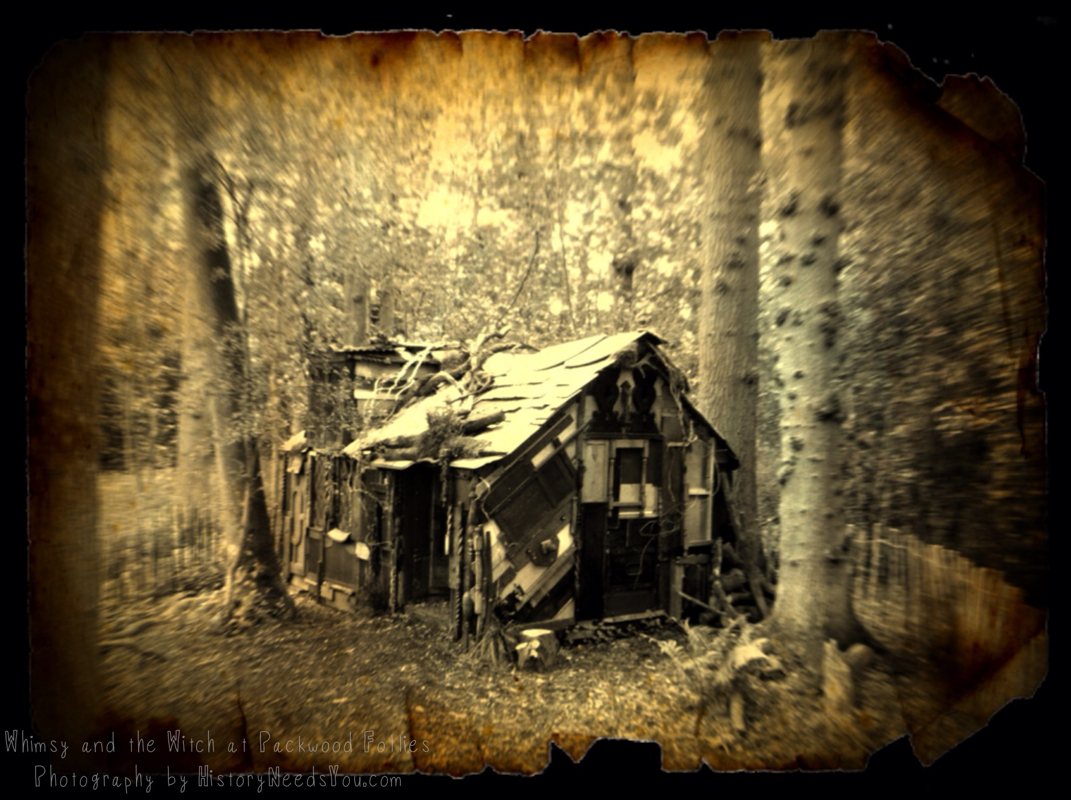 Whimsy and The Witch All was quiet, save the choirs of birdsong in the branches, yet our innocent wonder was challenged by the wicked witch who claimed ownership of the folly. Packwood Follies are a wonderful attraction that I encourage all to visit, to play in and enjoy. The brand new visitors' centre at Packwood House is excellent, with an comfortable tea room, free wifi and most importantly, a warm welcome from staff and volunteers. Please visit the National Trust website to plan your own visit.
More than four and a half centuries of history abound at Packwood. Now blessed with the wonderful whimsy and the witch, of Hilary Jack's follies. Thank you to Hilary Jack for discussing her inspiration. For more information about her work, please visit her website. Matthew Ward A journey into fear, brutalising the boundaries of theatre and theme parks. The Facility is a horror maze built in Birmingham but constructed in the consciousness of the customers. Imagine a twisted hybrid of The Twilight Zone, Crystal Maze and Shawshank but with dizzying disorientation and in your face frights. People arrive as happy customers but are dragged into a sadistic scientific experiment and become the lab rats in the cage. A cage welded together from nightmares and insanity, emanating from the brilliantly twisted minds of the creators. Queuing to be processed in The Facility unsettles the punters. Initially chatty, a skirling soundscape soon stuns their innocent insouciance. Screams from processed victims and howls from within the walls sows disquiet in their bones. Knowing they are about to be processed but with absolutely no idea what that means, they could walk away, they could choose to leave. But then the steel door opens. Like lambs to the slaughter, they file in fearfully. No longer punters, they are now experimental subjects. 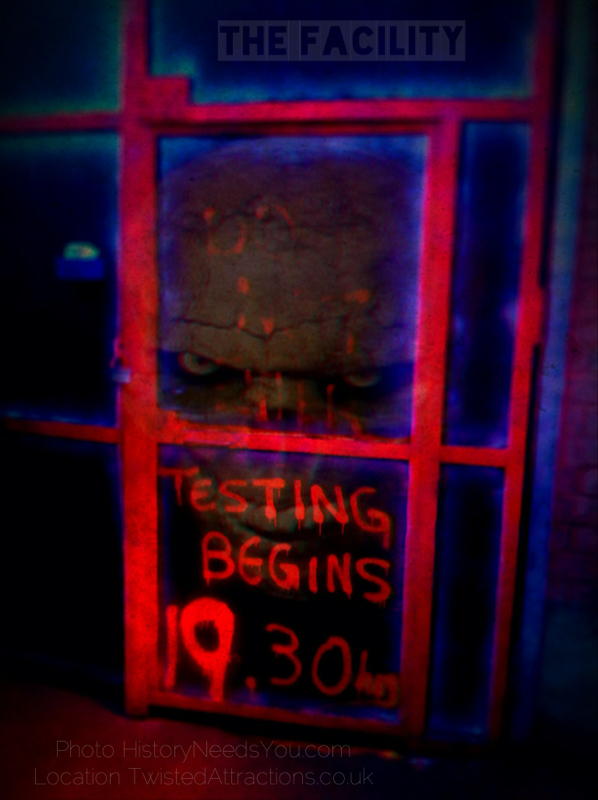
The sinister steel door to The Facility
And then it begins. Ordered by anonymous military and medical personnel, subjects are selected, numbered and told to obey the strict rules. Resistance, in the best Vogon tradition, is futile. Any subject foolish enough to revolt against authority is guided, in no uncertain terms, back on to the painful path of processing. The disorientation and psychological pressure increases inexorably. There are no safe spaces within The Facility or the swirling psyches of subjects. Computer-driven effects amplify and enhance the true special effects; the staff and permanent patients of The Facility. Played by an excellent team of actors, they expose the subjects to madness, not at arms' length but barely at nose length. They know the secret ways through the maze, enabling them to appear from every unexpected direction. All sense of time and orientation is taken from the subjects, and the only way out is a harrowing descent into the darkened depths of The Facility. Contorted patients scream from the cells and writhe in their shackles. They are the victims of the sadistic scientists, now merely statistics of medical failure. Like irradiated incubi and savage succubi, they want to share their infection with the processed subjects, enticing, entreating and excoriating. I thought I was protected by rationality as I analysed The Facility. When the walls moved and patients roared, I recalled the classic Psychology experiments conducted by Zimbardo and Milgram. My sang-froid was swiftly shattered by a psychotic patient wielding my personal phobia and I ran from The Facility with the other screaming subjects. 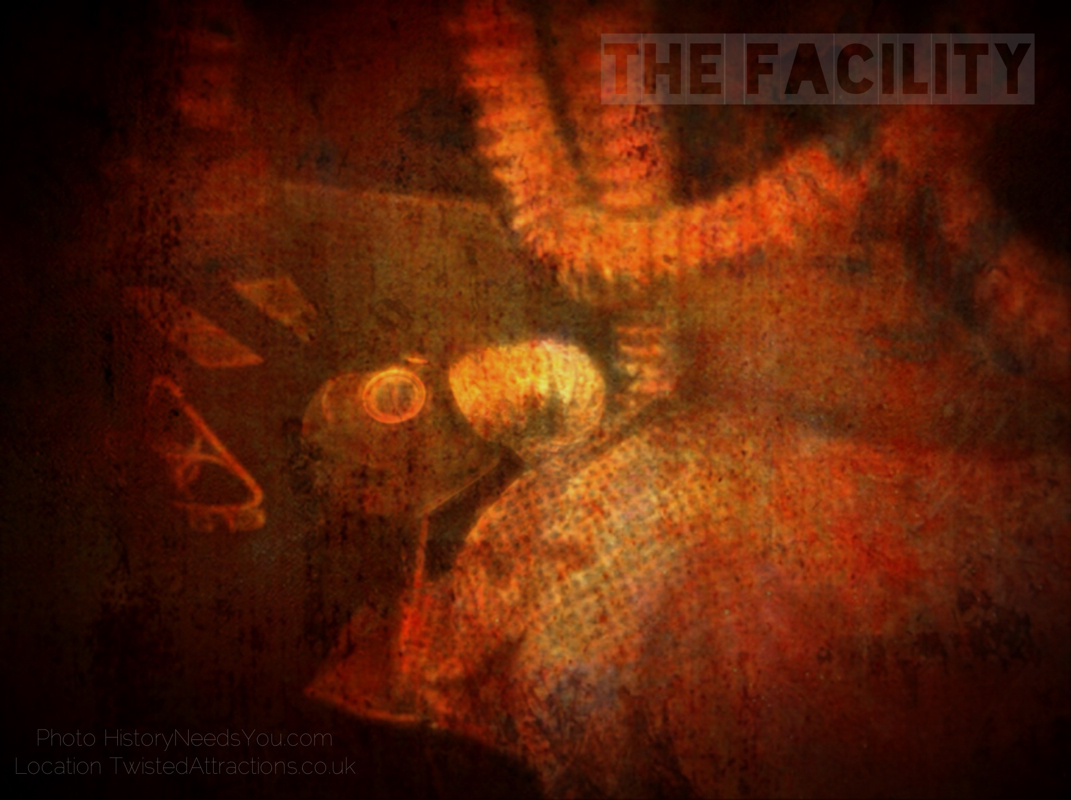
Testing in progress at The Facility
If you are brave, or foolish enough to be processed, you can book your journey into fear on twistedattractions.co.uk Standard ticket price is £8.50 with special deals for groups and extreme experiences. Every single subject that I interviewed thought it was fantastic value and far better than any horror movie or theme park. Please do read the warnings on the website very carefully and take heed. This is not a journey for the young, the infirm or faint hearted. Don't wear high heels and glamorous clothes. Even I dressed down for the occasion. Leave your bags and hats safely at reception and don't even think about taking a camera or phone. There are no opportunities for photography in The Facility. I only managed to smuggle out two photos. Despite the psychological terror, The Facility is physically safe. Subjects are closely monitored and there are escape routes, so the only real danger is within the mind. You have been warned. Will you be processed in The Facility? Matthew Ward 23/5/14  Nightfall over Europe The Deputy Prime Minister said, in a speech at Oxford this week: 'Isolationists. They are not thinking about Britain's interests. They shroud their narrow nationalism in the language of patriotism. They mask their hostility towards Europe as British bulldog spirit. But these are false patriots.' http://www.bbc.co.uk/news/uk-politics-27496450 I spoke with Adrian Goldberg @RealADGoldberg on BBC WM @BBCWM in a discussion about Nick Clegg's headline-grabbing comment. Adrian chaired an on-air debate and passionate views were expressed on both sides of the argument. One lady recalled her childhood during WW2 when the skies of Europe were dark with bombers, and declared she is against positive engagement with our partners in Europe. The bombers darkening the skies of Britain during WW2 were not only Dorniers and Junkers from Germany but also Wellingtons and Lancasters, flying from here to bomb people in Europe. My parents witnessed this two-way traffic during their wartime childhood and members of my family were killed and injured. When I was a child, the skies were still dark with bombers. I remember the way my school-mates would cheer when 'Concorde' flew over our school. I didn't cheer because I knew it wasn't Concorde but a delta-winged Vulcan bomber. And it was armed with a nuclear bomb. 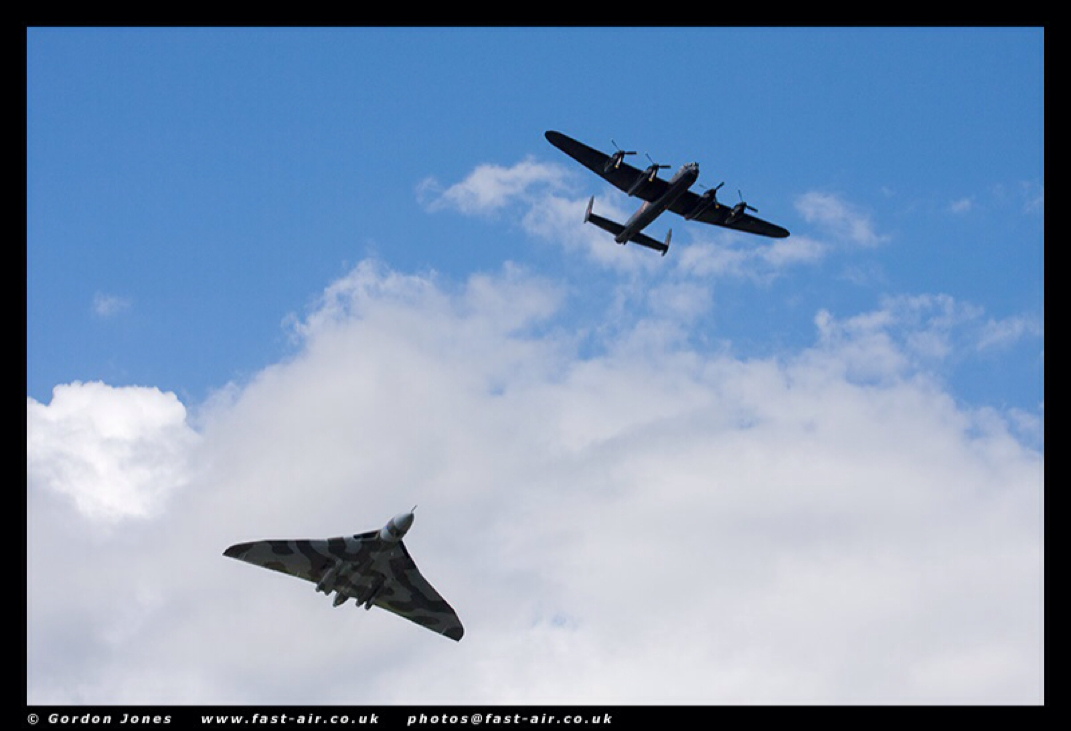 Avro Lancaster and Avro Vulcan Avro made both the Lancaster bomber of my parents' childhood and the Vulcan bomber of my childhood. Both aircraft threatened friend as much as foe. Our Lancaster bombers killed French and other allied people during WW2 in what is now cruelly dismissed as collateral damage. They also killed thousands of German children who were utterly innocent of any crime and were not responsible in any way for Hitler and the Shoah (Holocaust). The Vulcan bombers I witnessed on a regular basis were threatening the very people who had sacrificed so much to defeat Nazism - Russians, Poles and Czechs. These people were not our enemy. NATO may have been locked in conflict with the Soviet Union and Warsaw Pact but the people of those countries remained our friends. After the fall of the Berlin Wall and the collapse of Soviet power, people from Eastern Europe were able to renew our friendship and in some cases, became new neighbours. We only survived WW2 because of the selfless service of brave people who joined us from all over Europe, from the Commonwealth, and from other allied nations. Mian Khan was barely more than a child when he was killed aged just 17 in 1944. This brave young man, a Muslim from Punjab, gave all his yesterdays so we may all have a peaceful and prosperous tomorrow. 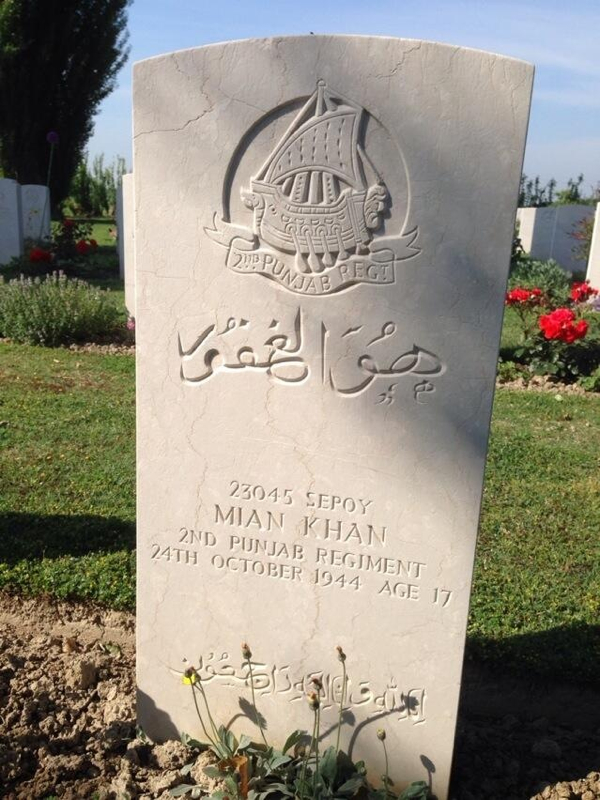 Mian Khan, a brave Muslim man from Punjab The central inscription on Mian's gravestone says 'He is the forgiver'; the lower is a verse from the Qur'an, 'We are from God, to Him we shall return'. Thank you to Riza Ünal @runal70 for kindly translating the beautiful Arabic script into English. Out of the dreadful maelstrom of WW2, a dream was born. A dream of a Europe of peace and unity. A dream that the continent would never again be scarred by the cruel claw of war. This is the dream upon which the EU was built. This is the dream that has ensured that we, the people of Europe, continue to solve our conflicts with negotiation and diplomacy and not with bullet and bomb. I am grateful to Khan and his friends, including my grandfather, for saving us in WW2. I am grateful for those who built the peace after the war, especially Clement Attlee who also helped to found the UN. I am grateful for leaders like Angela Merkel who have prevented the division of Europe and the return of war in the chaos following the financial crisis of 2007/2008. 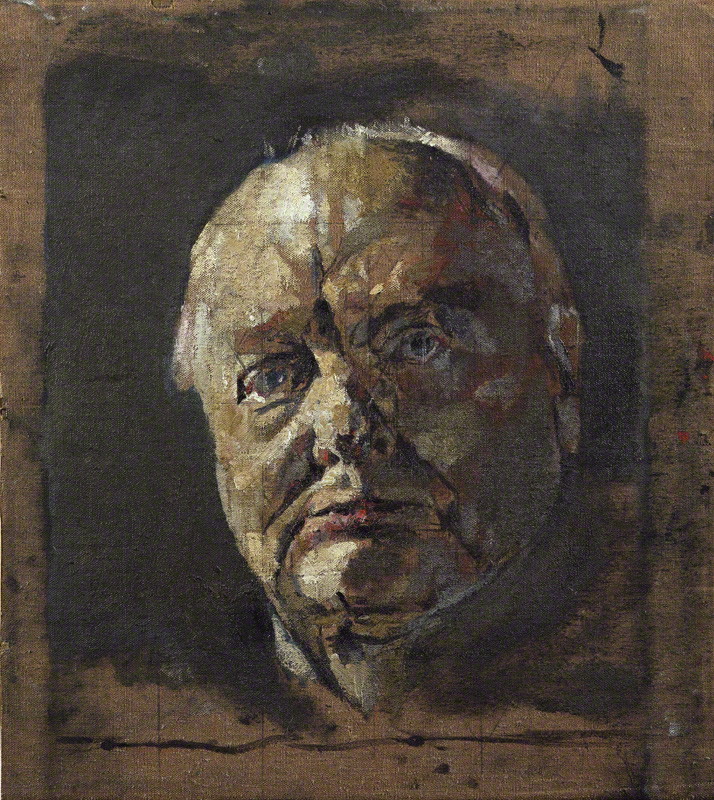 Winston Churchill by Graham Vivian Sutherland, 1954. In the National Portrait Gallery @NPGLondon Winston Churchill was an inspirational war leader but he campaigned equally vigorously for peace after 1945. He famously said in 1954 that 'jaw-jaw is always better than war-war'.
A peaceful, united Europe is the embodiment of that sentiment and I always vote to support it. I am avowedly politically neutral and am personally middle of the road and centrist. I value politicians of all parties who work for unity and prosperity for all. I know many excellent Councillors, MEPs and MPs from the Conservative, Green, Labour and LibDem Parties and also many good independents too. I wish them all well in these elections. Please vote in the local and European elections on 23 May 2014. Please vote for a candidate who will work diligently to serve the people. Please vote for a candidate who supports positive engagement in Europe. Please vote for peace, prosperity and unity. Please vote against hatred, division, racism and discrimination. Politicians that promote these views are not only cruel and dangerous but are traitors to our forebears who won the war and built the peace. Matthew Ward, 21.05.14 |
Archives
January 2017
Categories
All
|

 RSS Feed
Copyright for all images and text on this website is owned by Matthew Ward Hunter and Gill Fraser Lee, @HistoryNeedsYou unless stated otherwise. Images and content may not be used elsewhere without permission.